
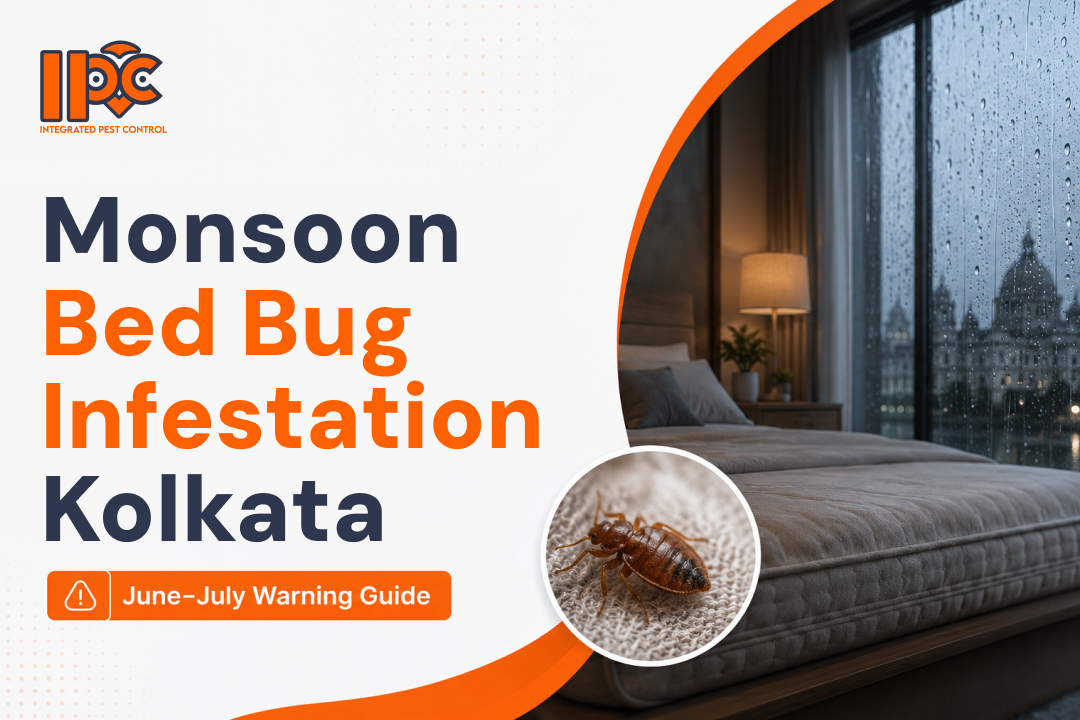
Monsoon Bed Bug Infestation in Kolkata: Your June–July Survival Guide
The first week of June arrives in Kolkata, and with it comes the familiar cocktail of heavy air, sudden downpours, and rising dampness inside every room. Most people brace for mosquitoes — but there's another pest that quietly explodes during this season, and it's one you don't see until you wake up covered in bites.
Bed bug infestation during monsoon months in Kolkata has become one of the most underreported urban pest problems in the city. While you're watching the rains from your window, these insects are reproducing in your mattress seams, headboards, and sofa joints at a pace that doubles in humid conditions. June and July are their peak months — and if you miss the early signs, what starts as a handful of bugs becomes a full-scale infestation within three to four weeks.
This guide covers why the monsoon triggers this surge, how to identify an infestation before it spreads, and what actually works to eliminate bed bugs in Kolkata's specific climate.
Why Monsoon Is the Worst Season for Bed Bugs in Kolkata
Humidity Above 70% Accelerates Bed Bug Egg Hatching
Bed bugs are not particularly fast breeders in cool, dry conditions. But the moment ambient humidity crosses 70% — which Kolkata surpasses routinely from June through August — their reproductive cycle accelerates dramatically.
According to research published by the National Pest Management Association, bed bug eggs hatch within six to ten days at 70–90% relative humidity, compared to up to 28 days in drier conditions. A single female bed bug lays between one and five eggs per day. In monsoon conditions in Kolkata, a modest infestation of 20 bugs can become 200 in less than a month.
The biology is straightforward: warm, moist environments keep eggs viable, speed up nymph development, and allow adult bugs to feed more frequently. Kolkata's June–July conditions essentially create a five-star nursery for them.
Why Kolkata's June–August Heat and Humidity Create Ideal Breeding Conditions
Kolkata sits in one of the most climatically demanding zones in India. June–August temperatures regularly hover between 30°C and 35°C, while relative humidity averages 85–90% during peak monsoon weeks. The India Meteorological Department classifies this period as the city's most thermally oppressive stretch of the year.
For bed bugs, this is perfect. They thrive between 21°C and 32°C and become more active as humidity rises. Kolkata's dense housing stock — older buildings with wooden furniture, thick mattresses, and low ventilation — gives them exactly the dark, warm hiding spots they need. A bed bug infestation during monsoon in Kolkata can spread through an entire flat within two weeks under these conditions.
How Monsoon Travel Spreads Infestations to New Homes
June and July are also when people travel — to escape the heat, for school holidays, or to visit relatives. Budget hotels, PG accommodations, trains, and shared transport are all common vectors for bed bug transfer.
A single piece of luggage that rested on an infested hotel bed can carry eggs into your home. Returning students moving back to PGs, domestic workers traveling home for the Eid or summer break — any movement of people carrying fabric items can introduce bed bugs into spaces that were previously clean. This is why the bed bug infestation during monsoon in Kolkata does not respect income levels or cleanliness standards. It's an environmental and logistical problem, not a hygiene one.
Early Warning Signs of a Bed Bug Infestation in Monsoon
Identifying an infestation early is the single most important factor in limiting both treatment cost and emotional stress. Here's what to look for specifically during the June–July period.
Rusty Spots on Mattress Seams and Headboards
The first physical sign most people notice is small, rust-coloured stains on their mattress — particularly along seams, buttons, and piping. These are either dried blood from a crushed bug after feeding, or faecal deposits that have spread slightly. Check your headboard joints and wooden bed frame edges as well.
Sweet, Musty Odour in the Bedroom
A moderate-to-severe bed bug infestation produces a distinctive smell — often described as sweet, slightly fermented, or vaguely almond-like. It comes from the scent glands bed bugs use to communicate. If your bedroom has an unusual, hard-to-source odour that doesn't go away with cleaning or ventilation, take it seriously. This smell intensifies in monsoon humidity.
Small Dark Faecal Spots on Sheets and Pillowcases
Check your pillowcases and lower bed sheets for tiny dark spots — smaller than a sesame seed — that smear slightly when pressed with a damp cloth. These are faecal marks. Unlike dust or dirt, they don't brush off cleanly.
Bites in Zigzag or Cluster Patterns
Bed bug bites appear differently from mosquito bites. Mosquitoes typically bite once or twice in isolated spots. Bed bugs feed in a line or cluster — often three to five bites in a row, sometimes called "breakfast, lunch, and dinner" by pest professionals. They tend to appear on exposed skin: forearms, neck, shoulders, and ankles.
The bites themselves may not itch immediately. Unlike mosquito reactions, bed bug bites often show up six to twelve hours after the feeding and can cause delayed allergic responses that worsen over successive nights.
Why Bed Bugs Are Harder to Eliminate in Monsoon
Humidity Makes Chemical Residues Break Down Faster
Most over-the-counter sprays rely on chemical residues that remain active after application, continuing to kill bugs that walk across treated surfaces. In high-humidity environments like Kolkata's monsoon season, these residues degrade significantly faster — sometimes within 24 to 48 hours — reducing their effectiveness.
Professional-grade products are formulated with higher stability, but even these require modified application protocols in humid conditions.
Monsoon Eggs Survive Most DIY Sprays
Here's what many homeowners don't realise: almost no spray product — professional or otherwise — can penetrate bed bug eggs. The eggs are covered in a sticky, waxy coating that repels most liquid-based treatments. In the monsoon, when egg production is at its fastest, spraying visible bugs only eliminates the adults and nymphs. The next generation hatches within a week and the infestation restarts.
This is precisely why a follow-up treatment within 10–14 days is non-negotiable for effective bed bug control in Kolkata's June–July window.
Air Conditioning Can Spread Them to Other Rooms
In buildings with ducted or split AC systems where internal units are placed in multiple rooms, bed bugs can travel through the unit housing and into adjacent spaces. This is more common in PGs, hotels, and older apartment buildings. If one room has an infestation and shares an AC wall unit with another, both rooms need to be treated simultaneously.
DIY vs Professional Bed Bug Treatment in Monsoon — What Actually Works
Treatment Comparison for Kolkata's Monsoon Conditions
Heat and steam treatments are the most effective options for a bed bug infestation during monsoon season in Kolkata. Temperatures above 50°C kill both eggs and adults within minutes, regardless of chemical resistance. The Centers for Disease Control and Prevention (CDC) confirms that sustained heat exposure is among the most reliable methods for eliminating bed bugs at all life stages.
Why a Follow-Up Treatment Is Critical
Given that eggs take 6–10 days to hatch, any treatment that does not include a scheduled follow-up is essentially incomplete. The second treatment, applied 10–14 days after the first, targets the new nymphs before they mature and begin laying eggs themselves. Skipping the follow-up is the single most common reason infestations return within a month.
Ask any pest control provider you engage whether a follow-up is included in their bed bug treatment package — if it isn't, it should be.
Bed Bug Prevention Tips for Kolkata Homes During Monsoon
Prevention costs far less than treatment. These practical steps significantly reduce your exposure during peak season.
Wash all linen at 60°C or higher — this kills both eggs and live bugs. Do this weekly during June–August.
Dry bedding in direct sunlight after rains — monsoon damp creates the exact conditions bed bugs love. Sun exposure helps reduce moisture in mattresses and cushions.
Use mattress encasements — certified bed bug-proof encasements trap existing bugs and prevent new infestations from accessing mattress interiors.
Inspect second-hand furniture before bringing it home — wooden bed frames, sofas, and bookshelves are common sources of introduced infestations.
Check your luggage after travel — especially after staying in budget hotels or PG accommodations. Leave bags in sunlight or store in sealed plastic for 48 hours before bringing them into your bedroom.
Reduce clutter near beds — boxes, clothes piles, and storage under the bed give bugs more hiding space and make inspection harder.
IPC Bharat's Guaranteed Bed Bug Treatment for Kolkata — Monsoon Season
IPC Bharat's Kolkata bed bug treatment service is specifically designed for the seasonal surge the city experiences in June and July. Their treatment protocol uses a combination of professional-grade sprays, targeted steam application, and a mandatory follow-up cycle that accounts for the egg hatching window — the step most providers skip.
For PG operators, hostel managers, and budget hotel owners, IPC Bharat also offers commercial treatment contracts that cover multiple rooms with documented service records. Given that a single infested room in a shared accommodation can spread to an entire floor within two monsoon weeks, this kind of structured approach is essential for commercial properties.
Learn more about the complete pest control services available across Kolkata and how to choose the right treatment for your specific situation.
Frequently Asked Questions (FAQ)
Q1: How quickly can bed bugs multiply during monsoon in Kolkata? In high humidity (above 70%), bed bug eggs hatch in as little as 6 days. A pair of bugs can produce a population of over 200 in 4–6 weeks during June–July conditions.
Q2: Are bed bug bites dangerous to health? Bed bug bites are not known to transmit diseases, but they cause skin irritation, allergic reactions, and significant sleep disruption. Secondary infections from scratching can occur. The World Health Organization notes that while not directly disease-transmitting, bed bugs cause considerable distress and anxiety.
Q3: Can I treat a bed bug infestation myself? DIY sprays can reduce visible bug populations temporarily, but they rarely eliminate eggs. In Kolkata's monsoon conditions, professional treatment with a scheduled follow-up is the only reliably complete solution.
Q4: How long does professional bed bug treatment take? A standard room treatment takes 45 minutes to 2 hours. You should stay out of the treated area for 4–6 hours after a chemical treatment. Heat treatments are faster but require professional equipment.
Q5: Do bed bugs only live in mattresses? No. Bed bugs live in any dark, warm space near a sleeping host: wooden bed frames, headboards, sofa joints, skirting boards, electrical outlets, picture frames, and luggage. A thorough treatment inspects all of these, not just the mattress.
Q6: Why do infestations worsen every monsoon even after treatment? Most treatments that fail in the long term missed the follow-up cycle, which targets freshly hatched nymphs. Additionally, re-introduction through travel or second-hand goods is common. A seasonal inspection in May before monsoon arrives is the best preventive step.
Conclusion
If you live in Kolkata and you've noticed unusual bites, faint musty odours, or tiny dark spots on your sheets — especially in June or July — don't wait. A bed bug infestation during monsoon in Kolkata escalates faster than at any other time of year, and the window between a minor problem and a building-wide crisis is short.
Act early. Get a professional inspection before the rains are fully underway, ensure any treatment you book includes a follow-up visit, and take basic preventive steps with your linen and luggage. The cost of catching this early is a fraction of what full-floor eradication costs later in the season.
Spotted signs already? Book a same-day bed bug inspection with IPC Bharat before the infestation spreads to more rooms.