
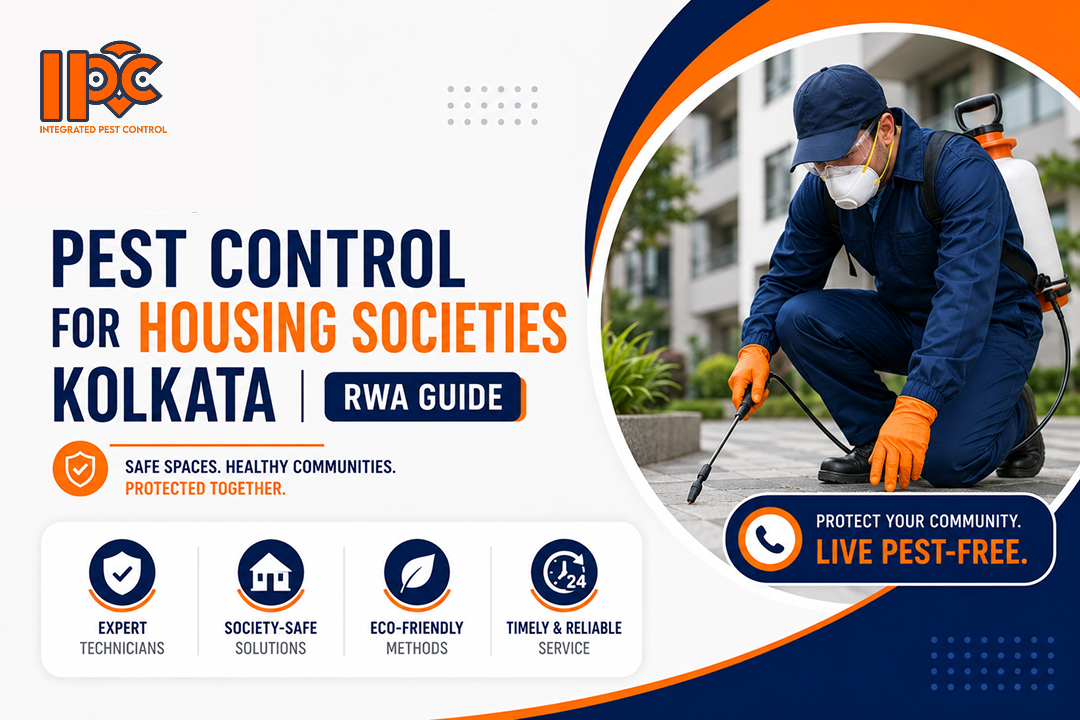
Pest Control for Housing Societies in Kolkata: The Complete Guide for RWA Committee Members
If you sit on your housing society's RWA committee, you already know this feeling: a flat owner messages the group at 11 pm complaining about cockroaches in the lift lobby. Someone else replies with a photo of a rat near the garbage room. A third resident demands to know what the committee is going to "do about it." And suddenly, pest control — something most people assume is a personal responsibility — lands squarely on your desk.
The reality is that pest control for housing societies in Kolkata is fundamentally different from treating a single flat. Pests don't read building floor plans. They travel through shared drainage pipes, crawl along cable ducts, breed in common-area gardens, and migrate between units without anyone's permission. Treating one apartment while ignoring the building's infrastructure is like mopping the floor while the tap is still running.
This guide is written specifically for RWA secretaries, committee members, and facility managers who need to make an informed decision — not just book a number from a pamphlet. We'll cover why society-level infestations happen, what a proper contract must include, realistic AMC pricing for 2026, and how to get flat owners on board before the problem gets out of hand.
Why Society Pest Management in Kolkata Requires a Specialized Approach
Most residents assume that if they keep their own flat clean, they're protected. That's understandable — but it's simply not how pests behave in multi-storey residential buildings. A cockroach colony living in the shared drainage system of a 12-storey building doesn't care which flat paid for pest control last month.
Shared Infrastructure Means Shared Risk
The biggest driver of recurring infestations in Kolkata apartment complexes is shared plumbing and drainage. German cockroaches — the small, fast variety most common in kitchens — travel vertically through wet walls and drainage risers. A colony on the ground floor can reach the fourth floor within weeks if the building's pipes aren't sealed properly.
Similarly, rodents use utility shafts, false ceiling gaps, and even electrical conduit ducts to move between floors and units. Treating individual flats addresses the symptom, not the source. The colony survives in the infrastructure, and the infestation returns — often to a different unit — within two to four weeks.
Common Areas Are the Real Hotspots
Most pest infestations in housing societies originate in common areas — not individual flats. The garbage room is the most obvious example: warm, moist, and full of food waste, it is a perfect cockroach and rodent breeding ground. Other overlooked hotspots include:
Lift shafts and machine rooms — dark, rarely inspected, ideal for cockroach nesting
Basement car parks — rodents breed under vehicles and along drainage channels
Terrace water tanks — stagnant water is the primary mosquito breeding site in residential buildings
Garden and landscaped areas — ant colonies, termite mounds, and mosquito larvae in standing water
Common stairwells — cockroach egg cases (oothecae) are frequently found in wall cracks here
When a committee focuses only on resident complaints from individual flats, these common-area sources are missed entirely — and the problem keeps cycling back, no matter how many times individual units are treated.
The Most Common Pests in Kolkata Apartment Complexes

Understanding what you're dealing with helps committees ask the right questions when sourcing a pest control partner. Here's what IPC Bharat's service teams encounter most often in Kolkata housing societies:
Cockroaches: The Most Complained-About Pest
Kolkata's combination of heat, humidity, and ageing building infrastructure makes it one of India's highest-risk cities for cockroach infestations. German cockroaches reproduce rapidly — a single female can produce over 300 offspring in her lifetime — which means a small colony becomes a large one in a matter of weeks.
Gel bait treatment, applied to cracks, hinges, and drainage access points across the entire building, is the most effective approach for society-wide cockroach control. A single flat treatment will not eliminate a colony that lives in shared drainage infrastructure.
Termites: The Silent Structural Threat
Subterranean termites are particularly destructive in Kolkata's older housing stock. They travel from soil through foundation walls and can silently consume wooden door frames, false ceilings, and furniture. Many building committees don't discover termite damage until it is already expensive. Learn more about professional termite treatment in Kolkata and why early detection saves significant repair costs.
Rodents: A Health and Property Risk
Rodents are not merely a nuisance — they carry leptospirosis, salmonella, and hantavirus, and cause significant structural damage by gnawing electrical wiring. According to the National Centre for Disease Control (NCDC), rodent-borne diseases account for a measurable share of annual vector-borne disease burden in Indian urban areas. In housing societies, the garbage room and basement car park are the primary entry and breeding points that need to be addressed at the building level.
What a Housing Society Pest Control Contract Must Include
This is where most RWA committees make their biggest mistake: accepting a quote based on price alone, without understanding what's actually included. A professional pest control contract for a housing society should specify all of the following:
1. Full Scope of Coverage
The contract must explicitly list every area covered: individual flats (if included), lift lobbies, stairwells, garbage rooms, car parks, garden areas, terraced and utility areas, and pump rooms. Vague language like "common areas as required" is a red flag.
2. Treatment Frequency and Schedule
A one-time treatment is rarely sufficient for a multi-unit building. Standard best practice for housing society pest control in Kolkata is:
Quarterly treatment for cockroaches and general pests (minimum)
Monthly monitoring visits for rodents where garbage density is high
Pre-monsoon and post-monsoon treatments for mosquito and termite prevention
Annual anti-termite soil or wood treatment for buildings with known risk
3. Licensed Technicians and Approved Chemicals
All pest control operators in India must be licensed under the Insecticides Act, 1968. Your contract should name the chemicals being used, confirm they are approved by the Central Insecticides Board & Registration Committee (CIB&RC), and confirm that all technicians hold valid operator licences. IPC Bharat operates fully under this regulatory framework, using only CIB&RC-registered formulations.
4. Written Treatment Records
Every treatment visit should result in a signed job card specifying: date, areas treated, chemical name and dosage, technician ID, and observed pest activity. These records are essential for any FSSAI-regulated food outlets within the premises, and for your own committee accountability to residents.
5. Service Guarantee and Re-Treatment Policy
A credible pest control company will offer a defined re-treatment window — typically 15 to 30 days — if significant pest activity is reported after treatment. Get this in writing before signing.
AMC Pricing for Housing Societies in Kolkata — 2026 Rates
Pricing for pest control for housing societies in Kolkata is almost always calculated on a per-unit basis, with discounts applied for larger complexes. Here is a realistic 2026 price guide based on market rates for quality, licensed service providers:
Note: Prices above are indicative. Final pricing depends on building age, infestation history, treatment type, and contract duration. IPC Bharat offers transparent, itemised quotes — request a bulk inspection for your housing society to receive a no-obligation, fixed-rate proposal.
One-Time Treatment vs AMC: Which Is Better for a Housing Society?
If you're weighing these options, our detailed comparison — One-Time Pest Control vs AMC in Kolkata — breaks down the cost, coverage, and long-term value for apartment complexes. The short answer: for buildings with more than 20 units, an AMC almost always delivers better value and more consistent results than repeated one-time bookings.
How Pests Spread Between Flats — And Why the Whole Building Must Act Together
One of the hardest parts of managing pest control for housing societies in Kolkata is getting residents to see it as a collective problem. The science is clear: individual treatment without coordinated building-wide action prolongs the infestation. We've written in detail about how pests spread between flats in apartments, but the key points for committee members to communicate to residents are:
A cockroach colony in shared drainage is not "your neighbour's problem" — it will reach your flat regardless
Gel bait treatment works through secondary poisoning — cockroaches carry bait back to the colony. This only works if multiple units in the same drainage zone are treated simultaneously
Rodents that are driven out of one treated unit will simply move to the next unit through shared wall gaps
Mosquito breeding in common-area water tanks affects every resident equally — no individual treatment solution exists for this
The most effective way to build consensus is to present a cost-per-flat figure — when broken down, society-level AMC costs less than most residents pay for a single-flat one-time treatment annually.
Getting Flat Owners to Participate: A Practical Approach for RWA Committees
Getting 50 to 200 flat owners to agree on anything is a feat in itself. Here's what works in practice:
Present the cost as a per-flat figure — ₹500–₹800 per flat annually sounds far more manageable than a ₹60,000 building quote
Share documented evidence — photographs of pest activity in common areas, and written complaints from multiple residents, make the case better than any argument
Frame it as property value protection — buyers and tenants in Kolkata now ask explicitly about pest management before signing rental or sale agreements
Start with a free building inspection — IPC Bharat conducts complimentary inspections for housing societies, which gives the committee a written report to present at the AGM
Tie it to the maintenance budget — most housing societies already allocate for building upkeep; pest control should be a named line item, not an emergency expense
Regulatory Compliance: What Housing Societies Are Required to Do
While there is no single national law mandating pest control in residential housing societies, several regulatory frameworks create obligations that committees should be aware of. The Food Safety and Standards Authority of India (FSSAI) requires documented pest control for any food outlet operating within a society premises — canteens, tuck shops, or even home bakeries with FSSAI licences. Municipal health inspections in Kolkata can also flag buildings with evidence of rodent activity as public health hazards.
Additionally, the West Bengal Municipal Act gives Kolkata Municipal Corporation the authority to issue notices to building owners and managing committees for maintaining conditions that promote vector-borne disease breeding. Documented, regular pest control is your committee's clearest defence against such notices.
Why IPC Bharat Is the Preferred Pest Control Partner for Kolkata Housing Societies
IPC Bharat has been providing certified pest management services in Kolkata and Guwahati for over 13 years. Our housing society programme is specifically designed for the challenges of multi-unit residential buildings — not adapted from a single-flat service model.
Licensed under the Insecticides Act 1968, with certified operators on every team
CIB&RC-approved chemicals — odourless gel formulations safe for kitchens, children, and pets
Dedicated treatment protocols for each common area — garbage rooms, car parks, lift shafts, garden areas
Written job cards after every visit, available for RWA records and FSSAI compliance
Transparent, per-unit AMC pricing with no hidden charges
Complimentary building inspection before contract signing — no obligation
Our cockroach pest control services in Kolkata and our termite treatment programme are both available under building-wide contracts for housing societies. Contact IPC Bharat today to schedule a complimentary society inspection and receive an itemised proposal for your committee.
Frequently Asked Questions
Q1. Who is responsible for pest control in a housing society — the RWA or individual flat owners?
Both parties share responsibility, but in different zones. The RWA or managing committee is responsible for common areas: lobbies, stairwells, car parks, garbage rooms, garden, and terrace. Individual flat owners are responsible for their own units. However, because pests move freely between these zones, a building-wide, coordinated approach always produces better results than each party acting independently.
Q2. How often should pest control be done in a housing society?
At minimum, quarterly treatment for cockroaches and general pests in all common areas. Rodent baiting should be checked monthly if the building has a garbage room or basement car park. Pre-monsoon (May) and post-monsoon (October) treatments are recommended as seasonal additions for mosquito and termite prevention.
Q3. What is a fair AMC price for pest control in a Kolkata housing society?
For a building with 50–100 flats covering common areas and key hotspots (garbage room, car park, garden), a realistic annual AMC ranges from ₹35,000 to ₹75,000 — approximately ₹500–₹800 per flat per year. Larger buildings with 200+ units can negotiate this down further. Always request an itemised quote.
Q4. Can residents request individual flat treatment as part of the society contract?
Yes, and this is in fact the most effective arrangement. When the society-level contract includes individual flat treatment, the gel bait's secondary poisoning effect reaches the entire colony simultaneously. Many housing societies in Kolkata now offer subsidised flat-level treatment as part of the common maintenance charge — residents pay a nominal per-flat contribution through the maintenance levy.
Q5. Do we need FSSAI-compliant pest control for our housing society?
If your society premises includes any food outlet — a canteen, bakery, tuck shop, or catering kitchen with an FSSAI licence — then yes, documented pest control is a legal requirement for that outlet. The pest control company must provide a treatment certificate with chemical details and a signed job card. IPC Bharat provides full FSSAI-compliant documentation with every treatment visit.
Q6. Will the treatment require residents to vacate their flats?
Gel-based cockroach treatment does not require vacating — residents can remain at home. Rodent baiting in common areas is also safe and non-disruptive. For general spray treatments (if used in common areas), a brief ventilation period of 2–3 hours is usually recommended. Your pest control provider should confirm requirements in writing before each treatment.
Conclusion
Pest control for housing societies in Kolkata is not a one-flat, one-time fix. It is a building-level programme that requires proper contracts, regular schedules, and the involvement of both the RWA committee and residents. When done right, it costs less per flat than most individual treatments — and it actually works.
The committee's job is not to personally manage infestations. It is to put the right professional partner in place, set clear contractual terms, and ensure accountability through proper documentation. A well-managed society pest control programme protects property values, prevents health hazards, and removes one of the most common sources of resident friction from your group chat permanently.
Ready to take the first step? Request a free building inspection and bulk quote from IPC Bharat — no obligation, no guesswork, just a clear proposal your committee can present and vote on.